
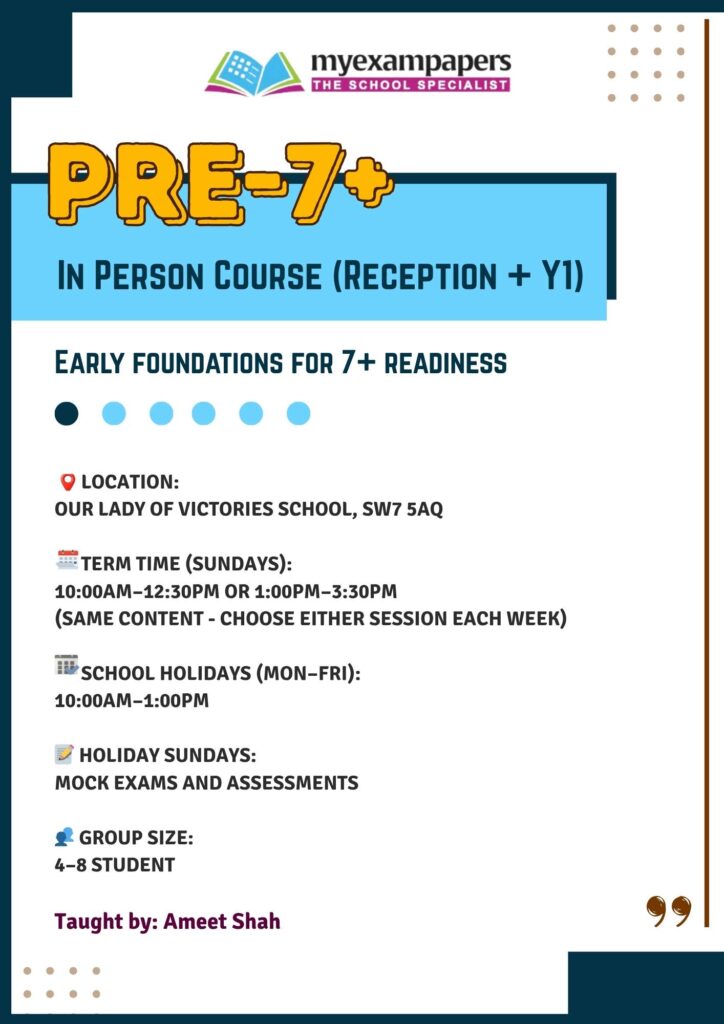
Pre-7+
For Reception and Year 1 children — building the early number sense, language, listening and thinking habits that make effective 7+ preparation possible.
£120/session
- *billed only when attended
- *no upfront term fee
- *payment methods + 1.8% card fee
- *sibling discount
📍 Location: Our Lady of Victories School, SW7 5AQ
📅 Term Time: Sundays: 10:00-12:30 or 13:00-15:30 (Same Content In Each Session)
🕙 School Holidays (Mon-Fri): 10:00am-1:00pm
📋 Holiday Sundays: Mock exams and assessments
👥 Group Size: 4-8 children
Location and Schedule
Venue
Our Lady of Victories School, Fulham Road, London, SW7 5AQ
**Holiday courses are occasionally held at Kent House, Knightsbridge. The confirmed venue is included in joining instructions sent before each term or course begins.
Schedule
Sunday Afternoon | 10 – 12:30
Sunday Afternoon | 13:00 – 15:30
Term
2nd February 2025 – 30th March 2025
Curriculum Details
Early Maths
- Number recognition and confidence with quantities
- Counting forwards/backwards; “more/less”; comparing groups
- Early number bonds (practical + quick recall)
- Patterns and sequencing (spotting rules)
- Simple problem-solving language (“How do you know?”)
Language & Listening
- Following multi-step instructions
- Listening comprehension through short spoken tasks
- Vocabulary building (describing, comparing, explaining)
- Speaking in complete sentences
- Retelling and sequencing (beginning/middle/end)
Thinking Skills
- Sorting, grouping and classification
- Spot-the-odd-one-out (reasoning language)
- Visual puzzles and pattern completion
- Focus training: start → sustain → finish
- Independence routines: check, correct, try again
Additional Resources
Weekly optional “5–10 minute” home activities
Termly readiness check-in: confidence, focus, early reasoning
Teaching Methodology – How sessions are run
Sessions are built around short, clearly structured activities. Children are stretched by depth rather than pace — the same task becomes harder when asked to explain their reasoning or find a different method. Praise is given for effort and persistence; errors are corrected calmly and specifically.
How to join
- Use the enquiry form on this page or message us directly.
- We will have a short conversation to confirm the right course and session time for your child.
- Once a place is confirmed, we will send details for your first session. Sessions are billed only when attended – there is no upfront term fee. Payment by bank transfer, cash or card.
- Joining instructions and venue details are sent before the first session.
Exam Details
How this prepares for 7+
Children in Pre-7+ practise listening carefully, thinking before answering, and explaining their answers to an adult. They build early number bonds and pattern awareness, and develop the sustained focus needed across a full session. This is learning done well — which prepares children more effectively than drilling at this age.
What selective schools assess at this stage
At 7+, schools are looking for children who are confident with numbers, communicate clearly, follow instructions accurately and respond positively to challenge. A child who has spent Reception and Year 1 building these habits is typically more settled and more capable under assessment conditions.